Influencing Gravitational Waves with Light
For over a century, gravitational waves existed only as a prediction in Albert Einstein's theory of general relativity. Their direct detection in 2015 by the LIGO collaboration marked a monumental leap in astrophysics. Now, a novel theoretical proposal aims to transform our relationship with these cosmic ripples—from passive observation to active interaction.
From Detection to Interaction: A New Experimental Vision
Theoretical physicist Prof. Ralf Schützhold of the Helmholtz-Zentrum Dresden-Rossendorf has introduced a groundbreaking concept. Rather than simply listening for gravitational waves, his proposed experiment would seek to exchange energy with them. This process hinges on the fundamental principle that gravity influences all forms of energy, including light. When a light wave and a gravitational wave meet, they can interact, allowing for a minuscule transfer of energy between them.
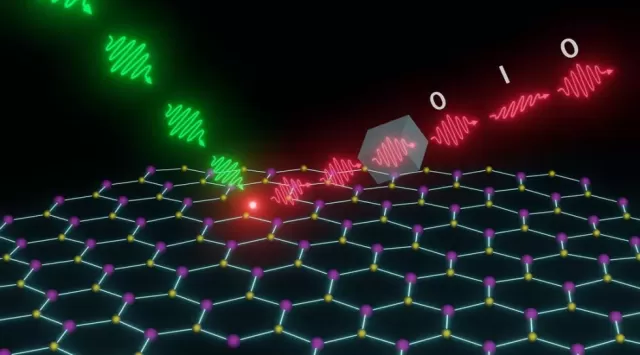
In this envisioned interaction, a beam of light could surrender a quantum of energy to a passing gravitational wave. This energy transfer would correspond to one or more gravitons—the hypothetical quantum particles of gravity. Consequently, the gravitational wave would become infinitesimally stronger, while the light wave would undergo a barely perceptible shift in its frequency.
The Two-Way Quantum Exchange
Crucially, this energy flow is reversible. The process can also occur where the gravitational wave donates energy to the light wave. This two-way street means scientists could, in principle, observe both the stimulated absorption and emission of gravitons. Measuring such an effect would provide compelling indirect evidence for the quantum structure of gravity, a cornerstone of theoretical physics that has eluded direct confirmation.
Engineering a Million-Kilometer Path
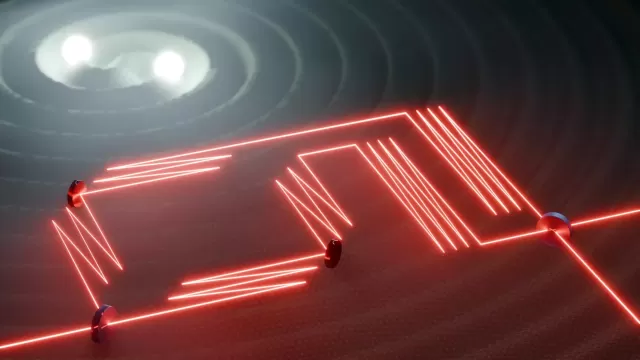
Detecting this subtle exchange demands an experiment of extraordinary scale and sensitivity. The proposal calls for laser pulses, likely in the visible or near-infrared range, to be reflected between two mirrors up to a million times. While the physical setup might span about a kilometer, the effective optical path length created by the bouncing light would stretch to approximately one million kilometers. This immense distance is necessary to amplify the tiny signal from the energy transfer to a measurable level.
Deciphering an Imperceptible Signal
The frequency change in the light from gaining or losing a graviton's worth of energy would be exceptionally small. To reveal it, the experiment would employ a precision interferometer. Here's how it would work:
- Two light waves would travel the extended optical path.
- Depending on whether they gain or lose energy from the gravitational wave, their frequencies would shift by slightly different amounts.
- Upon recombining, these waves would create a distinctive interference pattern.
- Analyzing this pattern would allow researchers to decode the minute frequency shifts and confirm the energy exchange.
Building on the Legacy of LIGO
While realizing this vision may take decades, it builds upon proven technology. The LIGO observatory, with its kilometer-long laser interferometer arms, has already mastered the art of detecting gravitational waves by measuring how they distort space-time by a fraction of an atomic nucleus. The new proposal extends this methodology from sensing distortions to facilitating a quantum conversation with the waves themselves.
A Window into Gravity's Quantum Nature
Looking ahead, Schützhold suggests that employing quantum light—specifically pulses of entangled photons—could dramatically boost the interferometer's sensitivity. This enhancement might allow the experiment to probe the quantum state of the gravitational field directly. A successful measurement would strongly support the existence of gravitons and our current quantum theories of gravity. Conversely, if the expected effects are absent, it would challenge fundamental aspects of modern physics.
This ambitious proposal to not just hear, but to gently push and pull on the fabric of space-time, has ignited considerable interest within the scientific community, opening a potential new chapter in our quest to understand the universe's most fundamental forces.