Chandra and ATCA Team Up to Unveil Secrets of Pulsar "Hand" Nebula
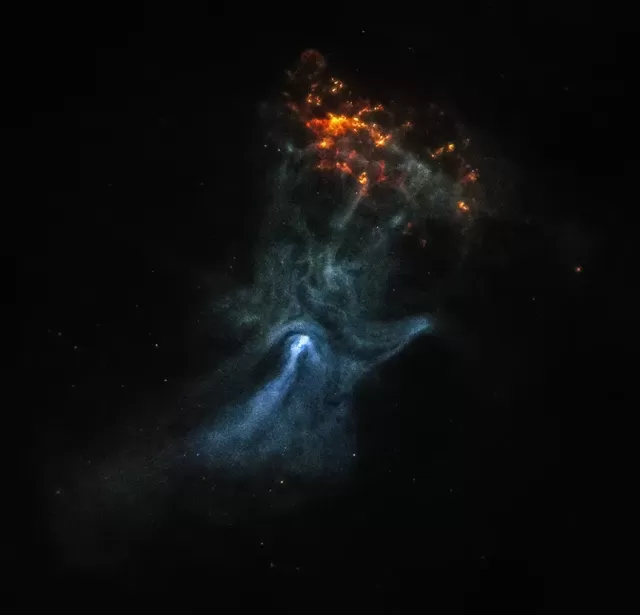
A celestial marvel, a pulsar encased in a nebula resembling a human hand, has captivated astronomers for years. Now, combining data from NASA's Chandra X-ray Observatory and the Australia Telescope Compact Array (ATCA), scientists have unveiled unprecedented details of this cosmic enigma. This collaboration sheds new light on the life cycle of massive stars and the exotic objects they leave behind.
At the heart of this spectacle lies Pulsar B1509-58, a rapidly rotating neutron star, a mere 12 miles across. This incredibly dense object is the engine driving MSH 15-52, a sprawling nebula stretching an astounding 150 light-years. The energetic particles emanating from the pulsar sculpt this nebula into a distinctive hand-like shape, visible primarily in X-rays.
This entire system originated from the cataclysmic collapse of a massive star. Once the star exhausted its nuclear fuel, gravity overwhelmed it, triggering a supernova explosion. The star's core compressed into a neutron star, while its outer layers were ejected into space.
B1509-58 spins at an incredible rate, nearly seven times per second, and possesses a magnetic field of immense strength, far exceeding that of Earth. This combination transforms the pulsar into a powerful electromagnetic generator, launching a relentless wind of charged particles that interact with the surrounding environment, forming the nebula.
The new composite image blends ATCA radio data (represented in red) with Chandra's X-ray observations (blue, orange, and yellow) and optical data highlighting hydrogen gas (gold). Overlapping regions of X-ray and radio emissions appear as purple, offering clues to the interactions between these different energy sources. The optical image reveals stars scattered across the field of view alongside remnants of the supernova explosion, known as RCW 89.
The ATCA radio data has uncovered intricate filaments that align with the nebula's magnetic field. These filaments are likely the result of the pulsar's particle wind colliding with the debris flung out by the supernova.
Comparing the radio and X-ray data revealed intriguing differences. Certain prominent X-ray features, such as the jet at the bottom of the image and the inner sections of the "fingers" at the top, were conspicuously absent in the radio observations. This absence suggests that highly energetic particles are escaping from a shock wave near the pulsar and tracing magnetic field lines to create the finger-like structures.
Furthermore, the radio data revealed that RCW 89 exhibits a structure distinct from typical young supernova remnants. The radio emission is uneven, closely matching clumps of X-ray and optical light, and extends beyond the X-ray emission. These characteristics support the theory that RCW 89 is colliding with a dense cloud of hydrogen gas.
Despite these advances, some puzzles remain. The sharp boundary of X-ray emission in the upper right of the image, believed to be the supernova's blast wave, is one such mystery. Typically, such blast waves are bright in radio waves, making the lack of a radio signal at this boundary a surprising anomaly.
MSH 15-52 and RCW 89 present a unique combination of features not seen in other young stellar remnants, but further research is needed to fully understand the complex interplay between the pulsar wind and the supernova debris, to unlock the secrets of their formation and evolution.