Electronic Eye Implant Restores Sight in AMD Patients
Groundbreaking advancements in medical technology have brought a new era of hope for individuals battling incurable sight loss. A revolutionary electronic eye implant, remarkably thin at just half the width of a human hair, has demonstrated the potential to restore meaningful vision in patients with advanced macular degeneration (AMD).
Clinical trials have revealed the remarkable impact of this sim card-sized prosthetic device. In a study involving 38 elderly individuals suffering from geographic atrophy, a severe form of dry AMD, the implant, dubbed the Prima device, enabled a significant percentage of participants to regain the ability to read letters, numbers, and even words.
Restoring a Sense of Independence
This breakthrough represents a monumental leap forward in the field of artificial vision. For the first time, blind patients are experiencing tangible central vision restoration. This newfound ability to read translates to a profound improvement in their overall quality of life, boosting their mood, confidence, and sense of independence.
The clinical trial results speak volumes, with 84% of participants experiencing a restoration of reading capabilities following the implant procedure. Experts in the field are hailing these outcomes as "remarkable," emphasizing the device's potential to benefit individuals grappling with the debilitating effects of dry AMD.
Understanding Geographic Atrophy
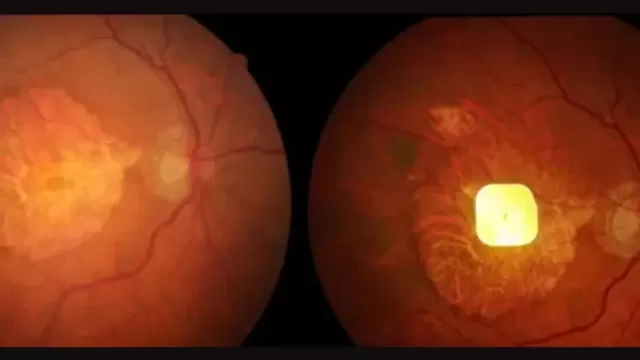
Geographic atrophy, a specific type of dry AMD, progressively robs individuals of their central vision. As cells within the macula, the central part of the retina, deteriorate, vision gradually diminishes. For many, this culminates in complete central vision loss, leaving only limited peripheral sight. Crucially, there is currently no established treatment for this devastating condition.
The Procedure and the Technology
The Prima device, a microchip measuring a mere 2mm by 2mm, is surgically implanted beneath the center of the retina through a vitrectomy. The procedure typically lasts less than two hours.
To facilitate vision and reading, patients utilize augmented reality glasses equipped with a video camera and a compact computer worn on their waistband. The glasses feature a zoom function to enlarge text for enhanced readability.
Here's how the technology works:
- Patients use the glasses to focus on and scan the desired object or text.
- The glasses project an infrared beam onto the implanted chip, activating the device.
- Artificial intelligence within the waistband computer processes the information and converts it into an electrical signal.
- This signal then travels through the retinal cells and optic nerve to the brain, enabling visual perception.
Rehabilitation is Key
While the implant represents a significant technological advancement, it is crucial to understand that it is not an instant fix. Patients must undergo dedicated training and intensive visual rehabilitation to fully realize the benefits of the technology. Learning to interpret and utilize this new form of vision is an essential part of the process.